Accelerating E-Learning Design with the Online Courses Web UI Kit
The digital education landscape has shifted dramatically over the last decade. What began as a supplementary resource for traditional learning has evolved into a primary mode of skill acquisition for millions. As the demand for high-quality online courses surges, so does the expectation for the platforms that host them. Learners today are discerning; they navigate complex information ecosystems daily and expect interfaces that are intuitive, visually appealing, and frictionless. For educators, entrepreneurs, and design agencies tasked with building these platforms, the pressure to deliver a polished user experience quickly is immense. This is where a specialized Online Courses Web UI Kit becomes an indispensable asset in the modern workflow.
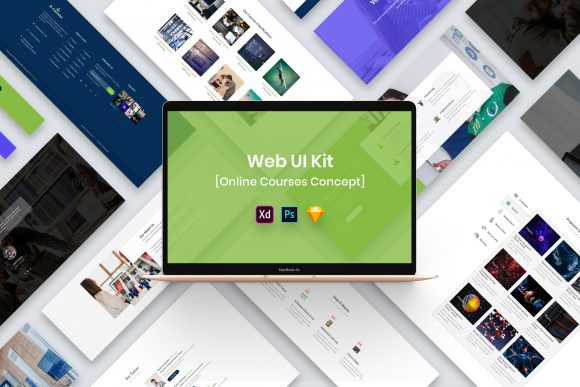
Designing an educational platform from scratch involves more than just arranging text and images. It requires a deep understanding of user journey mapping, information architecture, and visual hierarchy. A robust Web UI Kit Template serves as a foundational blueprint, offering a Modern and Minimal design aesthetic that aligns with current web standards. By leveraging pre-built components, creators can bypass the tedious initial stages of wireframing and focus on customization and content strategy. The availability of such kits in multiple formats—specifically PSD, Figma, Sketch, and Adobe XD—ensures that regardless of the design tool preference within a team, the workflow remains seamless and collaborative.
The Shift Toward Minimalism in Educational Interfaces
In the past, educational websites often suffered from cluttered layouts, overwhelming navigation menus, and inconsistent typography. These elements created cognitive load, distracting learners from the actual material. Today, the trend has decisively moved toward Minimal Design. This approach prioritizes clarity and purpose, stripping away non-essential elements to highlight what matters most: the course content and the learning path. A well-crafted UI kit embodies this philosophy by providing Purposeful Elements that guide the user naturally through the interface.
Minimalism in this context does not mean a lack of features; rather, it means those features are presented with intention. When you utilize a template with Well organized Widgets, you gain access to components like course progress bars, instructor profiles, lesson lists, and review sections that are designed to be unobtrusive yet highly functional. This design language resonates with modern users who value efficiency. Whether the audience consists of corporate professionals upskilling for a promotion or hobbyists exploring a new passion, a clean interface reduces frustration and increases engagement rates.
The evolution of user expectations dictates that a platform must look professional immediately upon loading. A Creative and Professional Design establishes trust. If a potential student lands on a site that looks outdated or disjointed, they may question the quality of the instruction itself. Using a pixel-perfect template ensures that every element, from buttons to icons, renders sharply across devices, including Retina Ready displays. This attention to detail signals competence and reliability, two critical factors in the competitive e-learning market.
Adapting to Diverse Workflows with Multi-Format Compatibility
One of the significant challenges in collaborative design projects is file compatibility. Design teams are rarely homogeneous; some members may swear by Figma for its real-time collaboration features, while others prefer the depth of Adobe XD or the vector precision of Sketch. Legacy workflows might still rely on PSD files for specific raster-based tasks. A versatile Online Courses Web UI Kit acknowledges this reality by including all four major formats. This inclusivity eliminates the need for time-consuming file conversions, which often result in lost layers or broken assets.
Having 4 Formats Included means that a project can start instantly, regardless of the agency's or freelancer's preferred stack. For a marketing team launching a new course series, this flexibility allows designers to hand off files to developers who might use different prototyping tools without friction. The Well-organized layers within these files are crucial. A chaotic file structure can turn a simple edit into a nightmare, but a kit with logical grouping and naming conventions empowers users to locate and modify specific elements rapidly. This organization is particularly vital when iterating on designs based on user testing feedback or stakeholder requests.
Furthermore, the Easily Editable files aspect cannot be overstated. Customization is key to branding. No two educational brands are identical; each has a unique voice, color palette, and mission. A Fully Customizable template allows designers to swap out colors, adjust typography, and rearrange layouts without breaking the underlying grid system. This adaptability ensures that the final product feels bespoke rather than generic, even though it started from a shared foundation.
Practical Implications for Creators and Businesses
For freelancers and small business owners, time is often the most scarce resource. Developing a comprehensive UI library from zero can take weeks. By integrating a high-quality UI kit into their process, they can reduce development time significantly, allowing them to launch courses faster and respond to market trends more agilely. This speed-to-market advantage is critical in niches where topics evolve rapidly, such as technology or digital marketing.
Consider an entrepreneur launching a niche course on sustainable architecture. They need a platform that reflects the eco-friendly, clean ethos of their subject matter. Using a minimal UI kit, they can quickly apply earthy tones and organic shapes to the pre-built widgets, creating a cohesive brand experience in days rather than months. Similarly, a corporate trainer developing internal modules for a large enterprise can use the Purposeful Elements to create standardized, professional-looking training materials that align with company branding guidelines.
The inclusion of Free Fonts is another practical benefit that streamlines the design process. Typography plays a massive role in readability, especially for text-heavy educational content. Knowing exactly which fonts are used—and having direct links to them in the Fonts Used file—removes the guesswork and licensing hurdles often associated with web typography. Designers can ensure that the text remains legible on all screen sizes, enhancing accessibility for all learners.
Navigating Asset Usage and Ethical Design Practices
While UI kits provide a robust framework, it is essential to understand the scope of what is included. In most professional templates, including this specific Online Courses Web UI Kit, the Images, Vectors, and Mock-ups seen in preview files are strictly for demonstration purposes. They are not included in the download package. This is a standard industry practice designed to respect intellectual property rights. The credits for these visual assets belong to their respective authors.
This distinction encourages creators to curate their own imagery, which is beneficial for brand authenticity. Stock photos can sometimes feel impersonal; by sourcing or creating original visuals that match the specific course content, educators can forge a stronger connection with their audience. The UI kit provides the stage, but the user provides the performance. This separation also ensures that the final design is unique and not instantly recognizable as a "template" to savvy users.
Moreover, working with Pixel Perfect files ensures that when you do insert your own images and vectors, they integrate seamlessly. There are no alignment issues or resolution mismatches to worry about. The precision of the underlying grid allows for a polished finish that rivals custom-coded solutions. For developers, this means less time fixing CSS alignment issues and more time focusing on functionality and backend integration.
Future-Proofing Your Educational Platform
The e-learning sector shows no signs of slowing down. As remote work becomes normalized and lifelong learning becomes a necessity, the number of online course providers will continue to grow. Standing out in this crowded marketplace requires more than just good content; it demands a superior user experience. Investing in a high-quality design foundation is a strategic move that pays dividends in user retention and satisfaction.
Trends in web design are moving toward greater interactivity and personalization. A modular UI kit allows for easier implementation of these features in the future. Because the elements are Fully Customizable and well-structured, adding new components like gamification badges, interactive quizzes, or community forums becomes a manageable task rather than a complete overhaul. The flexibility of the Modern and Minimal design ensures that the platform does not look dated within a year, providing longevity to the investment.
Ultimately, the goal of any educational platform is to facilitate learning. Every design decision should support this mission. By utilizing a comprehensive Web UI Kit Template that offers PSD, Figma, Sketch, and Adobe XD compatibility, creators can ensure that their technical setup supports their pedagogical goals. The combination of Creative and Professional Design with practical usability creates an environment where students can thrive.
In conclusion, the transition from concept to a fully functional online course platform is complex, but it doesn't have to be daunting. With the right tools, specifically a versatile and well-organized Online Courses Web UI Kit, designers and educators can bridge the gap between vision and reality. By embracing minimalism, leveraging multi-format flexibility, and adhering to professional asset management practices, stakeholders can build digital learning environments that are not only beautiful but also deeply effective. The focus remains firmly on the learner, empowered by a design that works as hard as they do.