Elevating Digital Interfaces with the Construction Icons Set, Flat Style
In the rapidly evolving landscape of digital design, the visual language we use to communicate complex ideas has become more critical than ever. For professionals ranging from web developers and mobile app creators to marketing strategists and independent freelancers, the choice of graphical assets can define the user experience. Among the most significant shifts in recent years is the widespread adoption of the Construction Icons Set, Flat Style. This collection represents more than just a set of images; it embodies a strategic approach to interface design that prioritizes clarity, speed, and universal understanding.
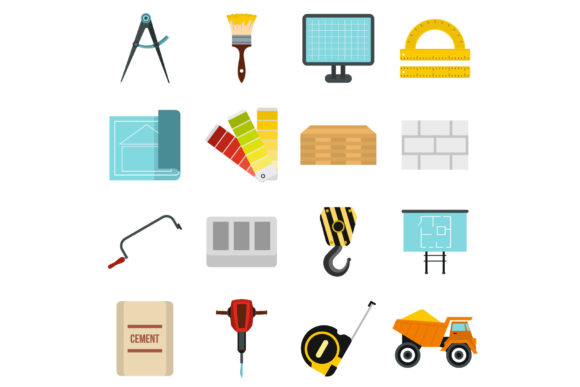
The modern digital ecosystem demands assets that are versatile enough to function seamlessly across various platforms while maintaining aesthetic consistency. The Flat construction icons set meets this demand by offering universal construction icons designed specifically for web and mobile UI. These elements serve as the building blocks for intuitive navigation and clear communication within applications related to architecture, engineering, project management, and real estate. By utilizing a set of basic construction elements isolated vector illustration, designers can ensure that their projects remain scalable and crisp on any device, from a high-resolution desktop monitor to a compact smartphone screen.
The Shift Toward Clarity and Minimalism
The rise of flat design was not merely an aesthetic trend but a response to the changing needs of users and the limitations of earlier design paradigms. As interfaces became cluttered with skeuomorphic details—textures and shadows meant to mimic real-world objects—users began to struggle with cognitive overload. The industry pivoted toward minimalism, stripping away unnecessary decoration to focus on core functionality. This is where the Construction Icons Set, Flat Style finds its strongest foothold. By reducing complex machinery, tools, and safety gear to their essential geometric forms, these icons convey meaning instantly without distracting the user.
Professionals in the technology and creative sectors are paying close attention to this style because it aligns perfectly with current consumer expectations for speed and efficiency. In a world where attention spans are shortening, the ability to communicate a concept like "hard hat," "crane," or "blueprint" in a fraction of a second is invaluable. The flat style eliminates visual noise, allowing the brain to process the icon's meaning immediately. This efficiency is crucial for mobile applications where screen real estate is limited, and every pixel must serve a purpose.
Adapting to Multi-Platform Workflows
One of the primary drivers behind the popularity of universal construction icons is the necessity for cross-platform compatibility. Today's entrepreneurs and marketers often launch products that must perform equally well on iOS, Android, and various web browsers. A fragmented asset library can lead to inconsistent branding and a disjointed user experience. The Construction Icons Set, Flat Style solves this by providing a unified visual system. Whether used in a project management dashboard or a consumer-facing home renovation app, these icons maintain their integrity and legibility.
The technical flexibility of these assets further enhances their relevance. Available in formats such as JPG, EPS, AI, PSD, PNG, and AI, this set caters to diverse workflows. Developers might prefer PNGs for quick implementation in code, while graphic designers working on high-fidelity mockups will leverage the scalability of EPS and AI vector files. The inclusion of PSD layers allows for deep customization, enabling teams to adjust colors to match specific brand guidelines without losing the sharpness of the original design. This adaptability ensures that the icons fit naturally into existing pipelines, whether the team is using Adobe Creative Cloud, Sketch, Figma, or other design tools.
Connecting Design to Industry Trends
The relevance of the Flat construction icons set extends beyond mere aesthetics; it mirrors broader developments in the construction and real estate industries themselves. As these traditional sectors undergo digital transformation, there is a growing need for software that simplifies complex processes. From Building Information Modeling (BIM) tools to supply chain management apps, the interface must reflect the precision and orderliness of the physical work being managed. Clean, flat icons provide a visual metaphor for this organized efficiency.
Furthermore, the global nature of the construction industry necessitates a visual language that transcends linguistic barriers. Universal construction icons act as a global dialect, understood by engineers in Tokyo, architects in Berlin, and contractors in New York. This universality reduces the friction in international collaborations and makes software more accessible to a wider audience. For marketers and entrepreneurs looking to expand their reach, utilizing a standardized set of basic construction elements isolated vector illustration ensures that their message is clear regardless of the user's native language.
Practical Applications in Modern UI
To understand the true value of these assets, one must look at their practical application in real-world scenarios. Consider a mobile application designed for facility management. The dashboard needs to display status updates for various building systems. Using a Construction Icons Set, Flat Style, a designer can create a clean grid where a wrench icon indicates maintenance, a helmet signifies safety compliance, and a crane denotes ongoing heavy lifting operations. The flat style ensures that even when dozens of these icons are displayed simultaneously, the interface remains uncluttered and easy to scan.
Another example lies in e-commerce platforms specializing in industrial equipment. Here, category navigation is key. Instead of using text-heavy menus, retailers can employ universal construction icons to represent categories like "Power Tools," "Safety Gear," or "Raw Materials." This visual approach not only speeds up the browsing experience but also adds a layer of professional polish to the site. It signals to the user that the platform is modern, efficient, and attentive to detail.
For freelancers and small agencies, the availability of these icons in multiple formats like AI and PSD is a game-changer. It allows them to deliver high-quality work to clients without the overhead of creating custom illustrations from scratch. This efficiency translates directly into better profit margins and faster turnaround times. By leveraging a pre-made yet highly customizable set, creatives can focus their energy on layout, interaction design, and strategy rather than getting bogged down in drawing individual bolts and beams.
The Future of Interface Assets
As we look toward the future of web and mobile UI, the principles underlying the Flat construction icons set will likely remain dominant. The move toward accessibility and inclusive design requires visuals that are high-contrast and easily distinguishable for users with visual impairments. Flat icons, with their bold shapes and lack of subtle gradients, often perform better in these contexts than their detailed counterparts. Moreover, as augmented reality (AR) and virtual reality (VR) begin to intersect with construction planning, the need for clear, recognizable 2D symbols that can overlay 3D environments will increase. These icons serve as the perfect bridge between dimensional data and user interpretation.
The changing preferences of consumers also play a role. Modern users associate clean, flat design with trustworthiness and technological sophistication. A cluttered or outdated interface can inadvertently signal that a company is behind the times. By integrating a modern Construction Icons Set, Flat Style, businesses signal that they are forward-thinking and aligned with current best practices. This psychological impact should not be underestimated, especially in competitive markets where first impressions are formed within seconds.
In conclusion, the adoption of universal construction icons is a strategic decision that impacts usability, brand perception, and operational efficiency. Whether you are a developer building the next great project management tool, a marketer launching a campaign for a new hardware store, or an enthusiast creating a personal portfolio, the right visual assets make all the difference. The Flat construction icons set offers the perfect blend of simplicity, versatility, and professional appeal. By utilizing these basic construction elements isolated vector illustration in formats like JPG, EPS, AI, PSD, PNG, and AI, creators can build interfaces that are not only beautiful but also profoundly functional. As the digital world continues to evolve, the commitment to clarity and universal design will remain the cornerstone of successful user experiences.